


 Spotify
 Apple Podcasts
 Amazon Music
 iHeartRadio
 RSS Feed
 Pandora
 Castbox
 Podcast Addict
 166 - "Time Ownership vs. Time Slavery: Why Most Entrepreneurs Accidentally Build a Prison"
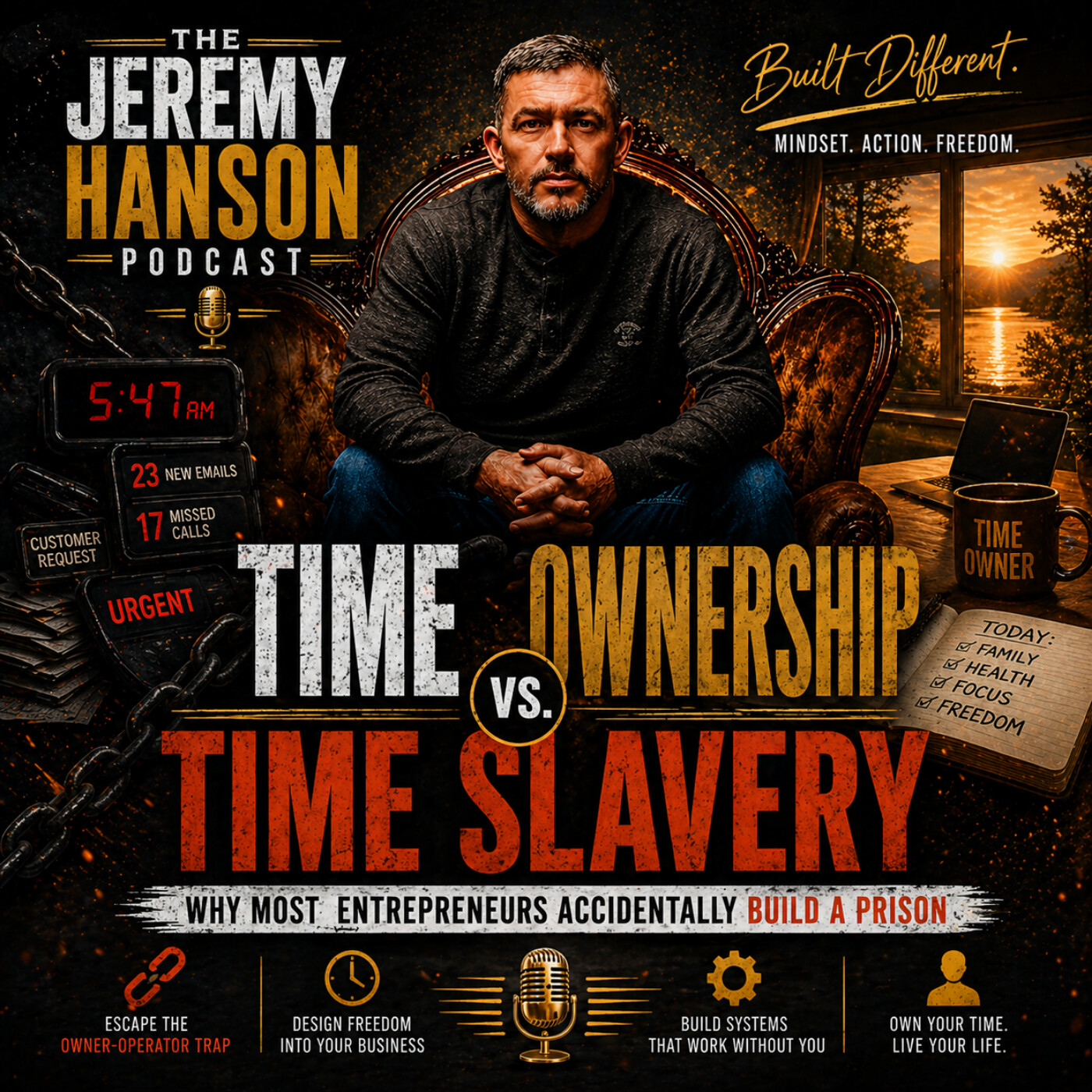
The Jeremy Hanson Podcast - "Time Ownership vs. Time Slavery: Why Most Entrepreneurs Accidentally Build a Prison"
It's 5:47 in the morning. The phone is already going. A customer wanting a quote. A crew member calling out. An invoice that didn't go through last night. Before your feet even hit the floor, the business has already claimed the first minutes of your day. You started this thing because you wanted freedom. You wanted to control your time. You wanted to stop asking permission to take a Tuesday off. And somewhere between that dream and this moment, something went wrong. You didn't build a business. You built a job. And unlike the job you left, this one never closes.
In this episode of The Jeremy Hanson Podcast, Jeremy delivers a hard-look diagnosis of the most dangerous trap in modern entrepreneurship. The trap that doesn't show up in any business plan, doesn't announce itself, and takes most owners years to even recognize. Time slavery. The slow, quiet hijacking of an entrepreneur's life by the very business they built to free themselves. He explains why the freedom most owners are chasing doesn't come bundled with the business license. Why entrepreneurship's first phase is not freedom but survival. And why, without the right architecture, growth doesn't liberate the owner, it buries the owner deeper.
Jeremy walks through how time slavery happens in degrees rather than all at once. The two emails answered after dinner. The Saturday call you take because it's a good customer. The Sunday night billing session because it's the only quiet time you've got. None of those feel like big decisions in isolation. But they set patterns. Patterns become expectations. And eventually customers, employees, and vendors all expect access to you on a schedule you never consciously agreed to. He calls this the entrepreneurial paradox. You start a business for freedom. The business becomes dependent on you. The more dependent it becomes, the less freedom you actually have.
The heart of the episode is a four-level model every entrepreneur moves through. Level One, the Worker, where your income is tied directly to your hours and stopping means revenue stops. Level Two, the Overloaded Owner, where you have employees and revenue but you are still the bottleneck for every decision. The burnout zone. Where most entrepreneurial stories end, not with failure, but with exhaustion. Level Three, the System Builder, where the work shifts from doing to designing, from solving each individual problem to building solutions that prevent the same problem from recurring. Level Four, the Time Owner, where the business operates on structure, problems get resolved without you in the room, and the owner becomes a leader instead of a frontline worker. Most entrepreneurs never make it past level two. The ones who do change everything.
Jeremy then names the strategic error that holds more operators at level one and two than any other single factor. They focus on revenue before structure. Growth before systems. Volume before process. He explains why growth without architecture actually produces more chaos, more problems, and less time, not the other way around. He uses a real story of a residential cleaning business owner who didn't double her revenue first or hire her tenth employee first. She wrote three documents... a checklist, a complaint script, and a pricing policy... and within ninety days her phone stopped ringing on Sunday nights. That's how level three actually starts. Not with a grand strategy. With a tired Sunday and a Word document.
The closing third of the episode is a tactical four-step path forward. Document Before You Delegate, with the practical hack of recording yourself doing tasks instead of trying to write a manual from scratch. Kill Repeated Decisions, with concrete examples of discount policies, callout policies, and weather policies that turn nightly fires into automatic procedures. Build Responsibility Layers, with a specific delegation sequence that has worked for dozens of operators... admin first, sales second, operations third. And Guard Your Schedule Like a Business Asset, the psychologically hardest step, where the owner has to deliberately step out of the hero role they've been playing for years.
This episode lands on a truth that took Jeremy years to fully understand. Money is a renewable resource. Time is not. The hour you spent answering emails at nine p.m. instead of sitting with your family is gone. It does not come back. It does not compound in your favor. It is simply gone. The most successful entrepreneurs Jeremy knows are not the ones with the biggest revenue numbers. They're the ones who have engineered their lives so that the business pays for the life they actually want to live. Revenue is not the scoreboard. Time ownership is. If your business is funding the life you want, you've won. If your business is consuming the life you want in order to grow itself, you've lost, even if the revenue keeps climbing. This is the conversation every operator needs and almost nobody is having out loud.
QUESTIONS THIS EPISODE ANSWERS
What is time slavery and how does it differ from just being busy? Time slavery is the slow, systematic hijacking of an entrepreneur's life by the business they built to free themselves. It doesn't show up overnight. It happens in degrees. Eventually customers, employees, and vendors all expect access to you on a schedule you never consciously agreed to, and the business has effectively occupied your life while you were calling it ambition.
Why doesn't more revenue solve the time problem? Because growth without systems produces more chaos, not more freedom. More customers means more problems. More employees means more management. More services means more potential failure points. Without architecture, every dollar of new revenue costs more of the owner's time to maintain.
What is the entrepreneurial paradox Jeremy describes? You start a business for freedom. The business becomes dependent on you. The more dependent it becomes, the less freedom you have. So the very thing you built to liberate yourself ends up consuming the time it was supposed to give back.
What are the four levels every entrepreneur moves through? Level One, the Worker, where you do everything and your income is tied directly to your hours. Level Two, the Overloaded Owner, where you have a team but you're still the bottleneck for every decision, the burnout zone. Level Three, the System Builder, where the work shifts from doing to designing. Level Four, the Time Owner, where the business operates on structure and the owner is no longer the bottleneck.
Why do most entrepreneurs stop at level two? Because growing past level two requires building systems instead of running on adrenaline, and that work doesn't feel productive in the short term. It looks like a quiet stretch where revenue isn't climbing while you're adding architecture. Most owners cannot psychologically tolerate that pause, so they stay on the treadmill of revenue-first growth and eventually burn out.
What is the strategic error that keeps owners stuck? Focusing on revenue before structure. Growth before systems. Volume before process. Revenue feels like proof, but growth without architecture actually produces more chaos, more problems, and less time. The fix is counterintuitive... build the foundation first, then let revenue follow.
What are the four practical steps to reclaim your time? One, Document Before You Delegate, by recording yourself doing recurring tasks. Two, Kill Repeated Decisions, by turning common scenarios like discounts and callouts into written policies. Three, Build Responsibility Layers, by delegating admin first, sales second, operations third. Four, Guard Your Schedule Like a Business Asset, by deliberately stepping out of the hero role.
Why is step four the hardest? Because it's psychological, not operational. You've spent years being the person who solves everything, and that identity feels essential. Stepping back on purpose feels like slacking off, even though it's actually doing the real job of an owner. The temporary discomfort of stepping back is the price of permanent freedom.
What does the woman with the cleaning business demonstrate? That moving from level two to level three doesn't require doubling revenue or hiring more people. It requires three documents... a checklist, a complaint script, and a pricing policy. Six total hours of writing. Within ninety days her phone stopped ringing on Sunday nights and the business kept running without her at the center.
What's Jeremy's final definition of winning in business? Not the biggest revenue number. The owner whose business is funding the life they actually want to live. Time ownership, family presence, clarity of mind, and energy at the end of the day are the real metrics. If your business is consuming the life you want in order to grow itself, you've lost, even if revenue keeps climbing.
time ownership entrepreneur, time slavery, owner operator trap, entrepreneur freedom myth, you built a job not a business, four levels entrepreneur, system builder business, time owner business model, escape the grind, entrepreneurial paradox, growth without systems, structure before revenue, business systems for service business, document before you delegate, kill repeated decisions, responsibility layers business, build delegation, guard your schedule, business should work for you, owner is the bottleneck, level two burnout, service business owner mindset, scaling small business, working in vs working on the business, business architecture, freedom in entrepreneurship, time vs money, money is renewable time is not, business funds your life, anti hustle entrepreneur, sustainable business growth, work life balance entrepreneur, family presence entrepreneur, owner identity shift, hero role entrepreneur, cleaning business systems, landscaping business burnout, service business systems, blue collar entrepreneur, Jeremy Hanson Podcast, Optimized Entrepreneur, Fuzzy Life Entertainment, tactical business advice, entrepreneur trap modern, build the vehicle not the treadmill, real scoreboard entrepreneurship, time as business asset, delegation sequence small business, admin first sales second operations third, recurring decisions policy, written policy for business, sunday night billing, after hours customer expectations, business owns you, employee of your own business, podcast for service business owners, entrepreneur exhaustion not failure, escape level two, become a time owner
ABOUT THE SHOW
The Jeremy Hanson Podcast is the no-fluff, anti-corporate business show for the operator class. Hosted by Jeremy Hanson, founder of multiple service businesses and creator of multiple podcast brands under Fuzzy Life Entertainment, the show delivers tactical, direct, ground-level business conversations for the people actually building. No motivational filler. No abstract theory. No business-school posturing. Just real lessons from the field on how to start, scale, and survive in the modern economy. New episodes drop weekly.
Sponsors
MR HANSoN Podcast www.MRHANSoNpodcast.com
Proraso Italian Shaving www.Proraso.com
QUESTIONS AND ANSWERS
Q: What is time slavery? Answer: The slow, systematic hijacking of an entrepreneur's life by the business they built to free themselves. It doesn't arrive all at once. It happens in degrees through small concessions that become patterns and patterns that become expectations.
Q: Why is the first phase of entrepreneurship not freedom? Answer: Because the first phase is survival. You leave a forty-hour-a-week job to build a business where you work seventy. You replace one boss with a customer base that expects you available around the clock. The freedom doesn't come bundled with the business license.
Q: What is the entrepreneurial paradox? Answer: You start a business for freedom. The business becomes dependent on you. The more dependent it becomes, the less freedom you have. The thing you built to liberate yourself ends up consuming the time it was supposed to give back.
Q: What are the four levels every entrepreneur moves through? Answer: Level One, the Worker, where you do everything. Level Two, the Overloaded Owner, where you have a team but you're still the bottleneck. Level Three, the System Builder, where the work shifts from doing to designing. Level Four, the Time Owner, where the business runs on structure instead of on you.
Q: What is the burnout zone? Answer: Level Two. The Overloaded Owner. Where you have customers, revenue, and employees, but you're still the center of every decision. Most entrepreneurial stories end here, not with failure but with exhaustion.
Q: What strategic error keeps most owners stuck? Answer: They focus on revenue before structure. Growth before systems. Volume before process. Revenue feels like proof, but growth without architecture produces more chaos, more problems, and less time.
Q: What's the cleaning business owner's lesson? Answer: She moved from level two to level three not by doubling revenue or hiring more people, but by writing three documents in six total hours. A checklist, a complaint script, and a pricing policy. Within ninety days her phone stopped ringing on Sunday nights.
Q: What is the documentation hack Jeremy gives in this episode? Answer: Don't try to write a corporate manual. The next time you do a recurring task, record yourself doing it. Voice memo. Loom video. Phone clip. Five minutes per task over thirty days builds a complete training library without ever scheduling time to "build a training library."
Q: What is the recommended delegation sequence? Answer: Admin first. Sales second. Operations third. You can't develop an operations leader if you're spending thirty hours a week on invoices and inquiry calls.
Q: Why is Step Four, guarding your schedule, the hardest? Answer: Because it's psychological. You've spent years being the hero, the closer, the fixer. That identity feels essential. Stepping back on purpose feels like slacking off, even though it's actually the real job of an owner. The temporary discomfort is the price of permanent freedom.
Q: What does Jeremy say is the real scoreboard for entrepreneurship? Answer: Not revenue. Time ownership. Family presence. Clarity of mind. Energy at the end of the day. If your business is funding the life you want, you've won. If your business is consuming the life you want in order to grow itself, you've lost, even if revenue keeps climbing.
The Jeremy Hanson Podcast on time slavery Jeremy Hanson on time ownership vs time slavery The four levels every entrepreneur moves through The entrepreneurial paradox episode You didn't build a business you built a job The owner is the bottleneck episode The system builder vs the time owner Document before you delegate Jeremy Hanson Kill repeated decisions episode Guard your schedule like a business asset The 5:47 AM wake-up call entrepreneur The cleaning business case study three documents Treadmill vs vehicle business Jeremy Hanson revenue before structure mistake Money is renewable time is not Jeremy Hanson Optimized Entrepreneur time ownership Fuzzy Life Entertainment Jeremy Hanson Anti hustle tactical business podcast Service business systems podcast Escape level two entrepreneur podcast Become a time owner Jeremy Hanson Build the business don't let the business build your cage
See Privacy Policy at https://art19.com/privacy and California Privacy Notice at https://art19.com/privacy#do-not-sell-my-info.