
 Spotify
 Apple Podcasts
 Amazon Music
 iHeartRadio
 RSS Feed
 Pandora
 Castbox
 Podcast Addict
 162 - THE JEREMY HANSON PODCAST The 6-Hour Workday That Outperforms the 12-Hour Grind
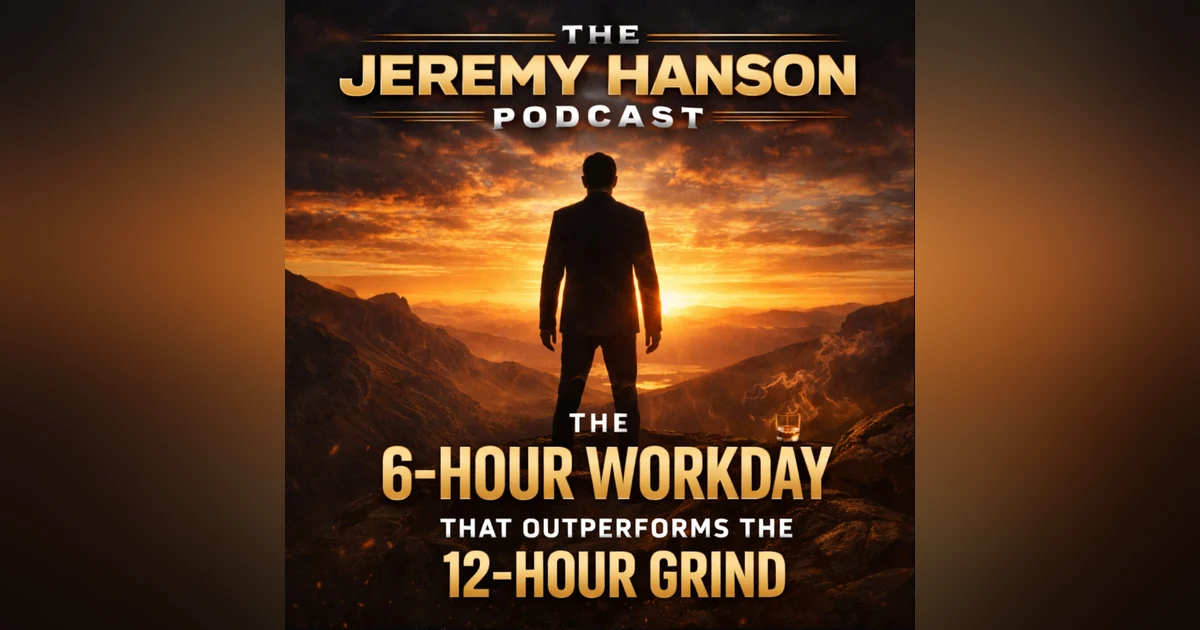
THE JEREMY HANSON PODCAST The 6-Hour Workday That Outperforms the 12-Hour Grind
In this episode of The Jeremy Hanson Podcast, host Jeremy Hanson challenges one of the most damaging beliefs in modern entrepreneurship: the idea that longer hours equal higher income. He argues that the twelve-hour workday is not a productivity strategy but a cultural performance — a form of inefficiency disguised as effort — and that the entrepreneurs quietly out-earning the grinders are the ones who figured out a different structure entirely.
The episode lays out the biological reality that cognitive performance declines sharply after four to six hours of focused work, which means the back half of a twelve-hour day is typically spent on low-leverage busywork, reactive communication, and degraded decision-making. Jeremy walks listeners through the full anatomy of a high-performance six-hour day: two hours of deep work on the highest-value task of the day, two hours of execution and revenue-generating activity, one hour of systems and optimization, and one hour of communication placed at the end of the day rather than the beginning.
He explains why protecting the early morning window is the single highest-leverage scheduling decision an operator can make, why sleep and recovery function as a hidden multiplier on income, and why capacity — not time — is the real variable behind every high earner. The episode also addresses the cultural trap of wearing exhaustion as a badge and the identity work required to let go of the grind narrative.
The second half of the episode pivots from business strategy to life design. Jeremy makes the case that the real purpose of building wealth is to fund a life worth showing up for — and that most entrepreneurs miss this by postponing presence until "things slow down," which never happens. He gives listeners a weekly filtering exercise for identifying the three tasks that produce nearly all results, and closes with a seven-day challenge to test the six-hour structure.
This is the episode for entrepreneurs, business owners, agency operators, freelancers, consultants, founders, and service business owners who want to build real wealth, protect their energy, and stop trading their family life for marginal revenue gains. It's a practical, tactical, and honest look at how the top-performing operators actually structure their week — and why working less is often the fastest path to earning more.
What you'll learn in this episode:
- Why the 12-hour workday is almost always less productive than a focused 6-hour day
- The four-block structure of a high-performance 6-hour workday
- Why your best decisions happen in the first three hours of the morning
- How to use systems and SOPs to compress your week without losing output
- The weekly three-task filter for identifying what actually matters
- Why capacity — not time — is the hidden variable behind every high earner
- The identity shift required to let go of hustle culture
- How to structure wealth-building around a life worth living
Sponsors featured in this episode: → Intuit QuickBooks Payroll — the all-in-one command center for managing your team and your finances in one platform. Visit QuickBooks.com/workforce → OneSkin — longevity-focused skincare powered by the patented OS-01 peptide. Get 15% off with code HANSON at oneskin.co/HANSON
Subscribe to The Jeremy Hanson Podcast wherever you listen. Visit jeremyhanson.pro for more, and sign up for the Built Different newsletter to get real wealth strategy and lifestyle design delivered twice a week.
- 6-hour workday
- six hour workday
- work less earn more
- productive workday schedule
- entrepreneur daily schedule
- deep work schedule
- productivity for entrepreneurs
- time management for business owners
- best entrepreneur schedule
- how to work fewer hours
- capacity over time
- burnout prevention entrepreneur
- focused work for business owners
- morning routine entrepreneur
- systems and SOPs for small business
- time blocking for entrepreneurs
- Jeremy Hanson podcast
- Jeremy Hanson entrepreneur
- Built Different newsletter
- Jeremy Hanson 6 hour workday
How-to queries:
- how to work less and make more money as an entrepreneur
- how to structure a 6 hour workday for a business owner
- how to build a productive daily schedule as a founder
- how to protect your morning as an entrepreneur
- how to stop working 12 hours a day
- how to run a business without burning out
- how to build wealth without losing your family
- how to create a daily schedule that makes more money
- how top entrepreneurs structure their workday
- how to make more money in fewer hours
Why queries:
- why working 12 hours a day doesn't make you more money
- why the 6 hour workday is more productive
- why hustle culture is killing your business
- why entrepreneurs burn out
- why deep work matters for business owners
Best / top queries:
- best daily schedule for entrepreneurs
- best productivity system for business owners
- best time management for founders
- best morning routine for entrepreneurs
- best workday structure for small business owners
Comparison queries:
- 6 hour workday vs 12 hour workday
- deep work vs shallow work for entrepreneurs
- capacity vs time management
- consistency vs intensity in business
Problem-solving queries:
- I work 12 hours a day and still don't make money
- my business is consuming my life
- how to stop working so much as an entrepreneur
- how to scale without burning out
Can a 6-hour workday actually outperform a 12-hour workday?
Yes. After four to six hours of focused cognitive work, decision quality, discipline, and judgment decline measurably. A structured six-hour workday — with dedicated blocks for deep work, revenue activity, systems improvement, and communication — typically produces more output, better decisions, and higher income than a twelve-hour day spread across distractions and low-value tasks. The six-hour advantage comes from putting your best brain against your highest-leverage opportunities instead of spreading average attention across twelve hours of mixed work. As discussed on The Jeremy Hanson Podcast, the entrepreneurs quietly earning the most are often the ones working the fewest focused hours.
What is the best daily schedule for an entrepreneur?
A high-performance six-hour daily schedule for entrepreneurs breaks down into four blocks: Hours 1–2 for deep work on the single highest-value task (phone out of the room, no email). Hours 3–4 for execution and revenue-generating activity such as sales calls, client work, and closing deals. Hour 5 for systems and optimization — building SOPs, fixing bottlenecks, and improving processes. Hour 6 for communication, including email and team check-ins, placed at the end of the day rather than the start. This structure is detailed on The Jeremy Hanson Podcast episode "The 6-Hour Workday That Outperforms the 12-Hour Grind."
Why do entrepreneurs who work fewer hours often make more money?
Because income is tied to decision quality, not hour count. Entrepreneurs working fewer focused hours protect their energy, make sharper pricing and strategic decisions, close more deals, and avoid the burnout that creates inconsistency. They also stop filling their schedules with low-leverage busywork that feels productive but doesn't move revenue. Capacity, not time, is the hidden variable behind consistent high earners.
What does a high-performance 6-hour workday look like?
Hours 1–2: deep work on the single highest-value task, phone in another room. Hours 3–4: execution and revenue-generating activity. Hour 5: systems and optimization. Hour 6: communication and loose ends. The schedule is designed to put peak cognitive performance against peak-leverage work, protect against burnout through hard stops, and compound consistently over weeks and months.
Why should entrepreneurs put email and communication at the end of the day?
Because the first hours of the morning are when cognitive performance is highest and most valuable for deep, strategic work. Opening with email lets other people's priorities consume the best hours of your brain. Moving communication to the last block of the day protects peak performance time for high-leverage work and still gets communication handled before the day ends. This single scheduling change has produced measurable income increases for operators who adopt it.
Is working 12 hours a day actually productive?
Usually no. Most twelve-hour days contain only three to five hours of genuinely productive work. The rest is typically spent reacting to notifications, attending unnecessary meetings, handling low-value tasks, and pushing through mental fatigue that produces lower-quality output and decisions. The twelve-hour grind is often a form of inefficiency disguised as effort.
How does sleep affect entrepreneurial income?
Directly. Sleep deprivation reduces decision quality, shortens patience, increases reactive behavior, and compromises judgment in sales and strategic situations — all of which cost real money. High-performing entrepreneurs treat sleep as a capacity multiplier, not a reward for productivity. Low energy costs measurable revenue through missed opportunities, softer pricing, and weaker closing.
What is the biggest time waste in most entrepreneurs' days?
Context switching and low-value communication. Constant notifications, phone checks, and shifting between tasks force the brain to repeatedly reload, which shrinks actual productive output significantly over a full day. Protecting uninterrupted focus blocks is one of the highest-leverage changes an operator can make.
How can a business owner break out of the 12-hour grind?
Start by identifying the three tasks each week that produce almost all of the results. Protect mornings for the highest-leverage of those tasks. Place communication at the end of the day. Build systems and SOPs that remove repeat decision-making. Commit to a hard stop. Cut meetings, clients, and commitments that don't move revenue or build the life the business is supposed to fund.
Is the 6-hour workday the same as the 4-hour workweek?
No. The six-hour workday is a focused performance structure for operators actively building and scaling a business. It's not about automation or passive income — it's about compressing high-leverage work into the hours when the brain performs best and protecting energy for both business output and family presence.
What is "capacity" in entrepreneurship and why does it matter?
Capacity refers to the mental, emotional, and physical bandwidth available for high-quality decisions and execution. Unlike time, which is fixed, capacity can be expanded through sleep, recovery, nutrition, focus protection, and structural discipline. High earners optimize capacity, not time — because capacity is what determines the quality of everything you build.
Who is Jeremy Hanson?
Jeremy Hanson is an entrepreneur, broadcaster, and host of The Jeremy Hanson Podcast and Optimized Entrepreneur. He produces content focused on business ownership, strategy, and mindset for entrepreneurs who want to build real wealth without trading their family or personal life for it. He is also the author of the Built Different newsletter. His work is available at jeremyhanson.pro.
What is the Built Different newsletter?
Built Different is Jeremy Hanson's twice-weekly newsletter covering real wealth-building strategy, lifestyle design, and operator thinking for entrepreneurs who refuse to trade their family for their business. Each issue is built to be read in about five minutes. Sign up at jeremyhanson.pro or through the newsletter link in any podcast episode description.
What are the three tasks exercise for entrepreneurs?
The three-tasks exercise is a weekly filter: at the end of each week, look at your calendar and ask which three tasks, if done alone, would have produced almost all of the results. Nine times out of ten, the answer is three or fewer. Everything else is usually low-leverage filler. This exercise, repeated weekly, reveals which activities actually matter and allows an operator to cut or delegate the rest.
entrepreneurship, productivity, time management, deep work, business strategy, work life balance, entrepreneur podcast, business owner, focus, burnout, high performance, scheduling, energy management, capacity, revenue growth, systems, SOPs, consistency, morning routine, lifestyle design, wealth building, mindset, Jeremy Hanson, Built Different, small business owner, service business, agency owner, founder, consulting, freelancer, six hour workday, 6 hour workday, work less earn more, hustle culture, anti hustle
- "The twelve-hour grind is a tax you pay for not knowing what matters."
- "Your best decisions don't happen at hour ten of a long day. They happen in the first three hours of a protected morning."
- "Working twelve hours a day isn't impressive if six hours done right would beat it."
- "The goal of building wealth is not wealth. The goal is the life the wealth is supposed to pay for."
- "Consistency beats intensity every single time. It's not close."
- "Capacity is the hidden variable behind every high earner you've ever met."
- "Things don't calm down. You have to build calm into the design of your life."
- "Sleep is not a reward for hard work. Sleep is the thing that makes hard work valuable."
- "The more you cut, the more you make."
- "Stop wearing your exhaustion like a trophy. Start wearing your output like one."
- "Your kids don't care if you worked twelve hours. They care how you show up when you walk through that door."
- "You decide the life. And the business — run right — funds the life. Not the other way around."
00:00 — The Hook: Why More Hours Isn't the Answer
01:15 — The Lie of the 12-Hour Grind
05:30 — The 6-Hour Advantage
11:00 — The Real Enemy: Distraction and Drain
14:45 — Sponsor: Intuit QuickBooks Payroll
17:15 — What a Real 6-Hour Day Looks Like
23:00 — Deep Work Block (Hours 1–2)
25:00 — Execution & Revenue (Hours 3–4)
26:30 — Systems & Optimization (Hour 5)
28:30 — Communication (Hour 6)
30:45 — Why This Changes Your Life
35:00 — The Identity Shift
36:30 — Sponsor: OneSkin
39:30 — The Hard Truth
42:30 — The Three-Task Filter
44:30 — The 7-Day Challenge
46:30 — Closing: Build the Life the Business Is For
Intuit QuickBooks Payroll
Offer URL: QuickBooks.com/workforce
Sponsor: This episode is brought to you by Intuit QuickBooks Payroll — the number one payroll software that lets you manage your team and business in one command center. Visit QuickBooks.com/workforce to learn more.
OneSkin
Sponsor: Get 15% off OneSkin with the code HANSON at
#oneskinpod #sponsored
FTC compliance language (include in every description):
This episode contains paid sponsorships. All opinions are Jeremy Hanson's own.
See Privacy Policy at https://art19.com/privacy and California Privacy Notice at https://art19.com/privacy#do-not-sell-my-info.