

161 - The Jeremy Hanson Podcast "The Hidden Multiplier: How Sleep and Recovery Are Secret Weapons for Entrepreneurs"
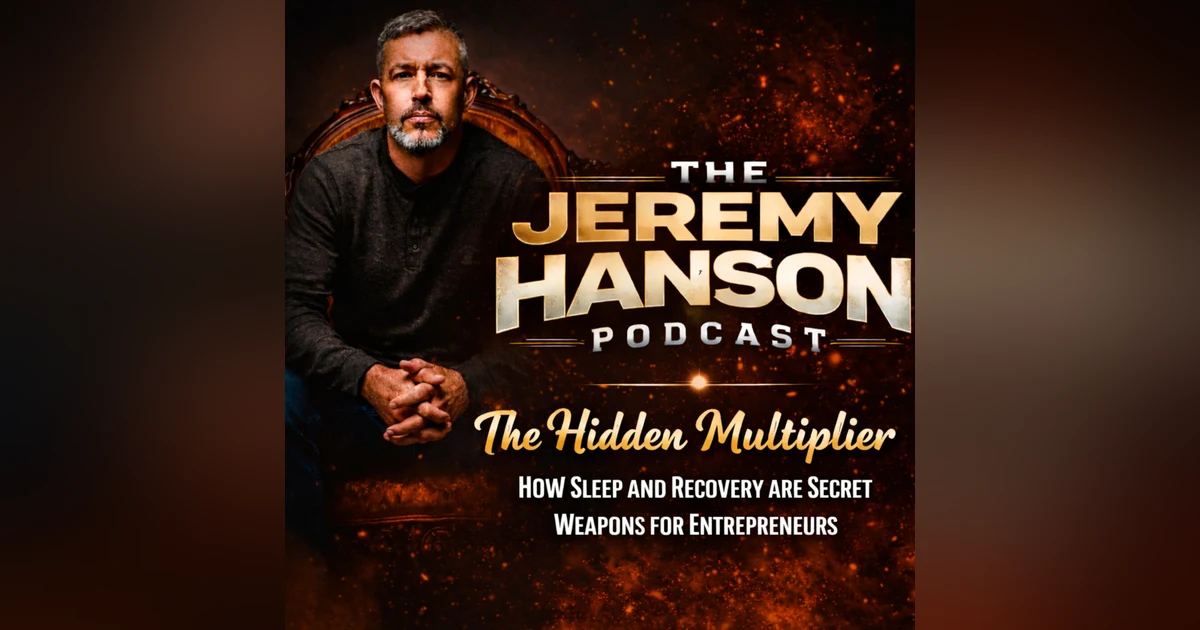


The Jeremy Hanson Podcast "The Hidden Multiplier: How Sleep and Recovery Are Secret Weapons for Entrepreneurs"
Most entrepreneurs don't have a marketing problem, a hiring problem, or a systems problem.
They have a sleep problem.
And in this episode of The Jeremy Hanson Podcast, host Jeremy Hanson lays out the research, the real-world cost, and the practical protocol — in direct, no-fluff terms built for business owners who want to perform at the highest level.
What this episode covers:
Jeremy opens with the data most entrepreneurs don't know: roughly 55% of startup founders struggle with sleep disorders, and nearly half of CEOs operate on fewer than six hours of sleep per night. He explains the neurological loop — how entrepreneurial stress elevates cortisol, which suppresses melatonin, which degrades sleep quality, which increases stress — and why most business owners never realize they're caught in it.
From there, Jeremy breaks down what sleep actually is. The four stages of sleep. What deep slow-wave sleep does for physical recovery and immune function. What REM sleep does for memory consolidation, creative problem-solving, and emotional regulation. And the 2013 University of Rochester discovery of the brain's glymphatic system — the waste-removal network that only activates during deep sleep and clears the same proteins associated with cognitive decline.
The financial cost section is where the conversation gets concrete. The RAND Corporation estimates sleep deprivation costs the U.S. economy $411 billion per year. Workers on fewer than six hours of sleep lose 11–19% of measurable productivity. Harvard research shows sleep deprivation produces cognitive impairment equivalent to a 0.05% blood alcohol level — legally drunk. And University of Pennsylvania research demonstrates that people adapt to feeling impaired without actually recovering — which means sleep-deprived entrepreneurs are making consequential decisions with impaired judgment and no awareness of it.
Jeremy also covers the hidden team tax — a 2016 Journal of Applied Psychology study confirming that leader sleep quality directly impacts team engagement, team mood, and team performance, even when team members have slept well themselves. A depleted leader doesn't just underperform; they pull the entire organization's output down with them.
The episode dismantles three persistent myths — that you only need five hours, that weekend catch-up sleep restores full function, and that successful entrepreneurs don't sleep — with specific research and named examples including Jeff Bezos, Arianna Huffington, Roger Federer, and LeBron James.
Recovery is addressed as its own category. Jeremy explains the difference between sleep and true nervous system recovery, the research on work-related rumination degrading sleep quality even when hours are adequate, and the concept of supercompensation — the same principle elite athletes use — applied directly to entrepreneurial performance.
The episode closes with a five-point practical sleep protocol: anchoring your circadian rhythm with a consistent wake time, protecting 90 minutes before bed as a business shutdown window, cognitive offloading to reduce nighttime rumination, daily movement as a sleep quality driver, and scheduling recovery as a non-negotiable business investment.
This episode is for: Entrepreneurs, small business owners, solopreneurs, service business operators, founders, and anyone building a business who wants to understand why performance, decision-making, and leadership all run through sleep quality.
Find additional resources for entrepreneurs and business owners at jeremyhanson.pro.
The Jeremy Hanson Podcast is produced by Fuzzy Life Entertainment.
- entrepreneur sleep
- sleep and productivity
- sleep deprivation business
- sleep for entrepreneurs
- recovery for business owners
- entrepreneur performance
- hustle culture sleep
- sleep science podcast
- business decision making
- entrepreneur burnout
- sleep quality tips
- cognitive performance sleep
- leadership and sleep
- entrepreneur health
- sleep productivity research
- REM sleep entrepreneurs
- business owner burnout
- sleep habits successful people
- entrepreneur stress sleep
- sleep deprivation cost
- why entrepreneurs don't get enough sleep
- how sleep deprivation affects business decisions
- sleep deprivation cost to small business owners
- cognitive impairment from lack of sleep entrepreneurs
- how sleep affects leadership and team performance
- REM sleep and creative problem solving for entrepreneurs
- sleep science for business owners and founders
- how to build a sleep routine as a business owner
- entrepreneur burnout from chronic sleep deprivation
- what successful entrepreneurs say about sleep
- does sleep affect business performance
- sleep deprivation equivalent to being drunk research
- how many hours of sleep do entrepreneurs need
- sleep recovery routine for high performers
- glymphatic system sleep and brain health
- sleep habits of successful CEOs and founders
- hustle culture and sleep deprivation damage
- how to sleep better when you own a business
- team performance and leader sleep quality
- why you can't catch up on sleep on weekends
- sleep as a business investment for entrepreneurs
- practical sleep protocol for entrepreneurs
- how stress from entrepreneurship causes insomnia
- RAND corporation sleep deprivation economic cost
- entrepreneur performance optimization through sleep
How does sleep deprivation affect an entrepreneur's decision-making?
Research from Harvard Medical School shows that sleep deprivation impairs executive function to the same degree as being legally drunk. After 17–19 hours without sleep, cognitive performance is equivalent to a 0.05% blood alcohol level. University of Pennsylvania research further shows that after 14 days of six-hour sleep, subjects developed the same impairment as 24 hours of total sleep deprivation — but did not feel impaired. This means sleep-deprived entrepreneurs are making consequential business decisions with degraded judgment and no awareness of the deficit.
What is the economic cost of sleep deprivation to businesses?
The RAND Corporation estimates that sleep deprivation costs the U.S. economy $411 billion per year through lost productivity, errors, and poor decision-making. Studies published in the journal Sleep show that employees operating on fewer than six hours of sleep lose 11–19% of measurable productivity. For business owners and entrepreneurs, the loss is amplified because all major decisions flow through a single individual operating at reduced cognitive capacity.
How does a leader's sleep quality affect their team's performance? A 2016 study published in the Journal of Applied Psychology found that leader sleep quality directly and significantly impacts team engagement, team mood, and team performance — even when team members have slept well themselves. Research from Simon Fraser University confirmed that when leaders were sleep-deprived, employees reported feeling less inspired and less committed, and produced lower performance ratings. Sleep-deprived leaders communicate with less precision, show reduced patience, and create a reactive environment that discourages early problem-reporting.
What happens in the brain during deep sleep and REM sleep? During deep slow-wave sleep, the body releases human growth hormone, repairs muscle tissue, and rebuilds the immune system. During REM sleep, the brain consolidates memories, processes emotional experiences, and strengthens creative problem-solving pathways. A 2004 study in Nature found that subjects who slept after learning a complex task were three times more likely to find a hidden solution than those who stayed awake. Additionally, the brain's glymphatic system — discovered at the University of Rochester in 2013 — activates only during deep sleep to clear metabolic waste, including proteins associated with cognitive decline.
Is it possible to catch up on lost sleep over the weekend? Research from the University of Colorado found that weekend recovery sleep does not fully restore cognitive performance lost during the week. Partial recovery occurs, but cumulative deficits from a week of under-sleeping are not completely reversed. Decisions made, opportunities missed, and relationships strained during sleep-deprived weekdays are not recoverable retroactively. Consistent nightly sleep is significantly more effective than attempting to compensate with extended weekend sleep.
How does entrepreneurial stress cause sleep problems? A 2019 study from the Journal of Business Venturing found that entrepreneurial stress directly elevates cortisol, the body's primary stress hormone. Elevated cortisol suppresses melatonin production — the hormone required to initiate sleep — creating a feedback loop where business-related stress causes sleep deprivation, which increases cognitive and emotional stress, which further degrades sleep quality. This cycle is a primary driver of the 55% rate of sleep disorders reported among startup founders.
How many hours of sleep do entrepreneurs actually need? The research consensus points to seven to nine hours for most adults. University of Pennsylvania studies show that six hours of sleep per night produces the same cognitive decline as total sleep deprivation within two weeks. Only approximately one to three percent of the population carries a genetic mutation allowing high function on six hours or fewer. The vast majority of entrepreneurs who report thriving on five to six hours have adapted to performing at a deficit without accurate self-assessment of their impairment level.
What is the glymphatic system and why does it matter for entrepreneurs? The glymphatic system is the brain's internal waste-removal network, discovered by researchers at the University of Rochester in 2013. It activates primarily during deep sleep and clears metabolic byproducts from neural activity, including amyloid-beta proteins associated with cognitive decline and Alzheimer's disease. Chronic sleep deprivation prevents adequate glymphatic clearance, leading to the gradual accumulation of neurological waste. For entrepreneurs who rely on cognitive performance as their primary business tool, this represents a long-term risk that does not appear on any financial statement.
What practical steps can entrepreneurs take to improve sleep quality? Evidence-based sleep improvements for entrepreneurs include: establishing a consistent daily wake time to anchor circadian rhythm; protecting the 90 minutes before bed from screens, emails, and business stress; using cognitive offloading — writing open tasks in a notebook before bed — to reduce nighttime rumination; incorporating 20–30 minutes of daily physical activity, which research shows improves sleep quality by up to 65%; and treating sleep and recovery time as scheduled, non-negotiable business commitments rather than optional recovery.
How does sleep affect creativity and innovation in business? A 2009 study published in the Proceedings of the National Academy of Sciences found that REM sleep specifically enhances creative problem-solving and the ability to make non-obvious conceptual connections. A landmark 2004 study in Nature demonstrated that sleeping after encountering a complex problem made subjects three times more likely to identify the hidden solution. For entrepreneurs who depend on insight, strategy, and adaptive thinking, sleep deprivation directly reduces the cognitive capacity most critical to long-term business success.
What do high-performing CEOs and athletes say about sleep? Jeff Bezos has publicly stated he prioritizes eight hours of sleep because it enables clearer thinking and more effective decision-making. Arianna Huffington collapsed from sleep deprivation and went on to become a prominent advocate for sleep as a performance tool. Roger Federer sleeps 11–12 hours when preparing for major tournaments. LeBron James has stated he aims for 12 hours. Sleep researcher Matthew Walker at UC Berkeley has documented that shorter sleep duration correlates with shorter lifespan. High-performing individuals across disciplines consistently treat sleep as a non-negotiable performance investment.
Where can entrepreneurs find more resources on business performance and optimization? The Jeremy Hanson Podcast covers practical business strategy, performance optimization, and entrepreneurial mindset for founders and business owners. Additional resources are available at optimized1.com, including tools and content built specifically for entrepreneurs who want to build profitable, sustainable businesses. The show is available on all major podcast platforms including Spotify and Apple Podcasts.
entrepreneur sleep, sleep deprivation, business performance, sleep science, entrepreneur health, hustle culture, REM sleep, deep sleep, cognitive performance, decision making, leadership performance, team management, burnout prevention, entrepreneur burnout, sleep productivity, sleep habits, high performance, business owner health, stress management, cortisol sleep, glymphatic system, sleep research, entrepreneur podcast, business strategy, recovery for entrepreneurs, sleep protocol, circadian rhythm, sleep quality tips, Jeremy Hanson, Jeremy Hanson Podcast, Optimized Entrepreneur, Fuzzy Life Entertainment, entrepreneur mindset, small business owner, business optimization
- "After 17 hours without sleep, your cognitive performance is equivalent to a blood alcohol level of 0.05. You would not negotiate a major contract drunk. But you'll do it on four hours of sleep — and your brain won't flag the difference."
- "Sleep-deprived leaders don't just underperform. They pull the entire team's output down with them — even when the team has slept well. That's the hidden team tax nobody budgets for."
- "The most dangerous lie in entrepreneurship isn't 'I can't afford to hire.' It's 'I'll rest when I earn it.' By the time you get there, the damage may already be done."
- "The University of Pennsylvania found that people who sleep six hours for two weeks develop the same impairment as someone who's been awake for 24 hours straight. The terrifying part? They don't feel that impaired. They've adapted to performing poorly."
- "Sleep isn't the opposite of productivity. Sleep is the foundation of it. Every good night of sleep makes the next day sharper. Every sharp day produces better decisions. Better decisions build the business you're actually trying to build. That's not soft. That's math."
CHAPTER TIMESTAMPS
00:00 — Cold Open: The Lie We Were Sold About Sleep and Success 02:10 — Introduction: Why This Episode Matters for Entrepreneurs 03:45 — Segment 1: The Entrepreneur Sleep Crisis — The Real Data 07:30 — Segment 2: What Your Brain Actually Does While You Sleep 13:00 — Segment 3: What Sleep Deprivation Is Costing Your Business 20:30 — [MIDROLL: Zapier] 23:00 — Segment 4: Creativity, Leadership, and the Hidden Team Tax 30:00 — Segment 5: The Long-Term Health Bomb 36:00 — [MIDROLL: Fabric by Gerber Life] 38:30 — Segment 6: Killing the Myths — Five Hours, Catch-Up Sleep, and "Successful People Don't Sleep" 44:00 — Segment 7: Recovery — The Missing Piece Beyond Sleep 48:30 — Segment 8: What High Performers Actually Do 53:00 — Segment 9: Your Five-Point Sleep Protocol 57:30 — Closing: The Investment That Compounds
The Jeremy Hanson Podcast is a business and entrepreneurship show for founders, operators, and small business owners who want real strategy, real research, and real talk — no motivational fluff, no corporate speak. Host Jeremy Hanson draws on 20-plus years of entrepreneurial experience across service businesses, broadcasting, and content production to deliver episodes that are immediately applicable and built for people who are actively building something. The show is produced by Fuzzy Life Entertainment at Fuzzy Life Studios. Find additional tools and resources for entrepreneurs at www.jeremyhanson.pro
www.zapeir.com/jeremy
www.meetfabric.com/hanson
See Privacy Policy at https://art19.com/privacy and California Privacy Notice at https://art19.com/privacy#do-not-sell-my-info.