

 Spotify
 Apple Podcasts
 Amazon Music
 iHeartRadio
 RSS Feed
 Pandora
 Castbox
 Podcast Addict
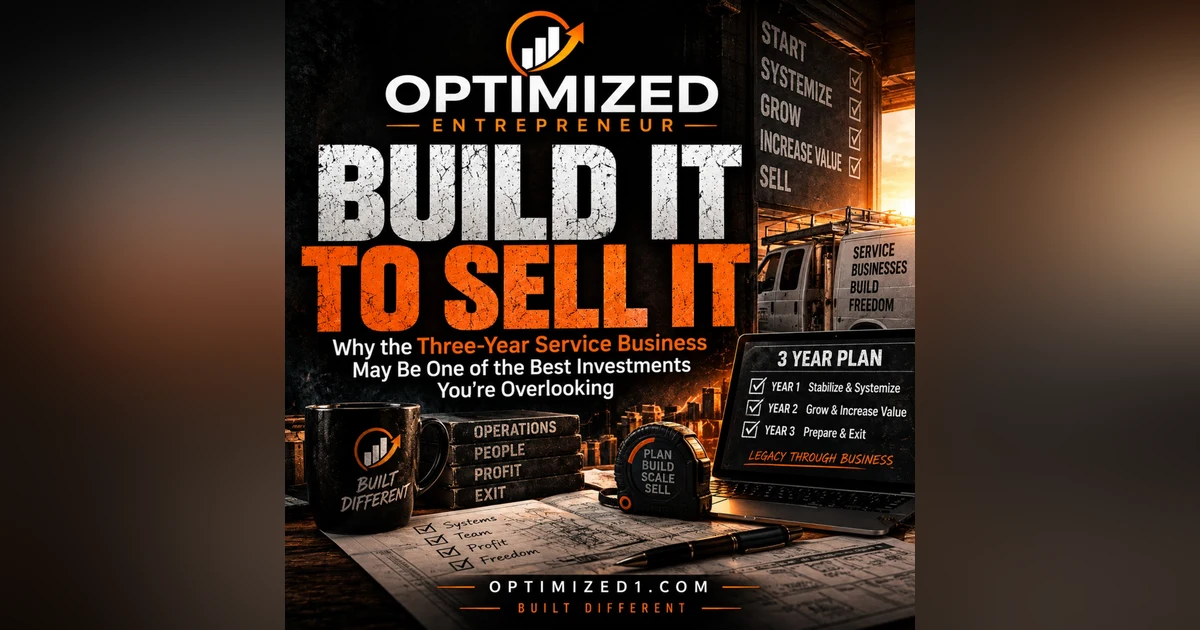
 BUILD IT TO SELL IT Why the Three-Year Service Business May Be One of the Best Investments You're Overlooking

Most entrepreneurs build a business they intend to keep forever, and a surprising number of them end up owning a job with a logo painted on the side of a truck. In this episode of Optimized Entrepreneur, Jeremy Hanson lays out a completely different model: choosing an unglamorous service industry on purpose, building the company as an asset from the first day of operation, and preparing it for a sale that may happen in thirty-six months. Pressure washing, HVAC, plumbing, landscaping, pest control, commercial cleaning, roofing, pool service, junk removal, property maintenance. Industries nobody writes articles about, fragmented across every market in the country, full of skilled technicians who never built an actual company. That gap is the opportunity.
Jeremy walks through the full three-year build. Year one proves the machine: choosing the market, the service line and the customer type, learning real customer acquisition, and documenting every process before volume arrives to hide the answers. Year two removes the owner from the center of the business, which is uncomfortable for the ego and excellent for the valuation, and includes the thirty-day disappearance test that exposes exactly how fragile a company really is. Year three polishes the asset and builds the diligence file a buyer will demand: clean financials, documented equipment, written standard operating procedures, customer acquisition data, retention numbers, revenue by service and by customer, and an honest measurement of concentration risk.
Along the way the episode covers why not all dollars of profit carry the same value, how recurring revenue and route density convert transactions into predictability, why the customer database is an asset most owners never organize, what buyers actually mean when they ask where your leads come from, and how these transactions get structured in the real world through cash at close, seller notes, earnouts, equity rollovers and transition periods. It closes with the question every owner should be able to answer on demand: if somebody walked in tomorrow and offered to buy this business, what exactly would they be buying?
Whether you intend to sell in three years or hold for thirty, the argument holds. Everything that makes a company attractive to a buyer makes it a better company to own right now. More predictable. More profitable. Less dependent on you. And more valuable every quarter you keep it.